
 Base and Derived Units

Click on the menu on the left to change the font of the text to your liking.
Click on the day and night icon to darken the background of the text.
📚 Base and Derived Units
(in simple terms)

2- 🎯 Take the Practice Quiz( Test your understanding )
What You'll Learn
📖 1 - What are base quantities and base units?

There are a very large number of quantities in science. Do we need to define a separate unit for all of them? Fortunately, the answer is no. In fact, all of them can be expressed in terms of seven quantities.
Quantities that have independent units and do not depend on other quantities are called base quantities. These seven quantities have been selected by international agreement. The characteristics of base quantities, which are commonly asked in exam questions, are usually as follows
📖 2 - Characteristics of base units
- The number of base quantities is seven.
- Their units are called base units.
- They are independent.
- They do not depend on other quantities.
- They are not expressed in terms of other quantities.
- They are not derived from other quantities.
- They have been chosen by international agreement.
📖 3 - The Seven Base Quantities
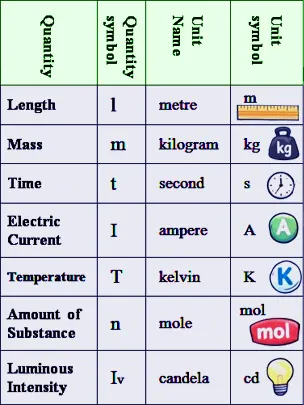
These seven base quantities were established by international convention. While other quantities could have been chosen, these seven were selected for their broad applicability in science and daily life.
Example: Measuring an object's length:
- Length = base quantity
- l = quantity symbol
- 5 = numerical value
- m = unit (meter)
MKS System: The first three quantities (Meter, Kilogram, Second) are so commonly used that the system is often called the "MKS System."
📖 4 - What is a derived (secondary) unit?
Derived units are measurement units created by combining base units. Unlike the seven independent base units, derived units express complex physical quantities.
For examples:
- Displacement is Base quantity and its Unit is meter (m)
- Time is Base quantity and its Unit is second (s)
- Speed is Derived quantity and its Unit is m/s (depends on m and s)
- Accelerationis Derived quantity its Unit is m/s²
📖 5 - Characteristics of derived units
The following characteristics may be used in exam questions:
- Their units are called derived units.
- They depend on base quantities.
- They are not independent.
- They are obtained from base quantities using formulas.
- They are numerous.
📖 6 - Special Named Derived Units
Some derived units have unique names honoring famous scientists. Despite their special names, these remain derived units—not base units.
Examples with Special Names
- Force: Newton (N) = kg·m/s²
- Pressure: Pascal (Pa) = N/m²
- Energy: Joule (J) = N·m
The following examples are important because they are very repetitive.
Frequency (hertz) – Force (newton) – Pressure (pascal) – Energy, work, heat (joule) – Power, radiant flux (watt) – Electric charge (coulomb) – Electric potential difference (volt) – Electrical resistance (ohm) – Magnetic flux (weber) – Magnetic field (tesla) – Temperature (celsius or kelvin) ...
✏️ example 1:
Determine whether the following statements are true or false:
- We can compare different quantities with the help of units.
- All quantities have a unit
- Area has a derived unit
- A quantity can have different unit
✅ answer:
- Yes, this is correct. This is exactly the purpose of a unit.
- Some quantities, such as the coefficient of friction and refractive index, do not have units.
- Yes, the unit of area, m2, is a derived unit.
- For example, length can be expressed in meters or in feet.
📝 Practice Quiz
base-derived-unit
Frequently Asked Questions
📌 What is a unit?
A unit is a specific amount of a quantity used to compare that quantity, so that a measurement can be made and a numerical value can be assigned.📌 How many types of units are there? Explain each.
There are two types of units: base units, which are independent, and derived units, which depend on base units.📌 What are the most important characteristics of a unit?
It must be reproducible – it must remain constant – it must be precise.📌 What are the base units?
Kilogram – meter – second – kelvin – ampere – mole – candelaWe Value Your Feedback
If you're satisfied with our service, a high rating would truly encourage our team. If you have concerns, we'd appreciate hearing your specific reasons in the comments so we can address them directly.
Number of votes = 1
Average rating 5 out 5
Comments Section
Answers to your questions about this lesson ( Base and Derived Units)Suggestions to improve site performance