
 Modeling in Physics

Click on the menu on the left to change the font of the text to your liking.
Click on the day and night icon to darken the background of the text.
📚 Modeling in Physics
(in simple terms)

2- 🎯 Take the Practice Quiz( Test your understanding )
What You'll Learn
📖 1 - How to Model in Physics?
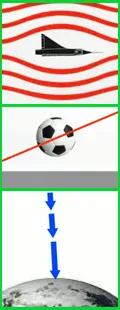 Modeling in physics means simplifying a phenomenon by ignoring less important details so it can be analyzed. Consider a leaf falling from a tree. Its motion is complex, but we assume its path is a straight line to simplify the problem. Usually, in kinematic physical modeling, the following simplifications are made:
- Air resistance is ignored; otherwise, the problem becomes too complex.
- Friction is assumed to be absent.
- Temperature effects are neglected.
- The shape of the object is not considered; for example, a truck is treated as a point.
- The effects of humidity and wind are ignored.
...
Note that the above simplifications are not always required. For example, without friction, a car cannot move or brake properly (e.g., on an icy road). Therefore, the conditions of the problem and the impact of simplifications must be considered. This is illustrated in the following examples.
📖 2 - Modeling Ball Motion in Air

We throw a ball. How can we create an acceptable model and which assumptions can be applied?
- The ball is considered a perfect sphere (in reality, its surface is rough with irregularities).
- We assume the ball is a point, meaning its dimensions are negligible. This assumption is common in many physics problems.
- We ignore the rotation of the ball around its axis (although the ball does rotate in reality).
- We ignore air resistance and wind effects (this is only valid if the ball moves in a vacuum, e.g., on the Moon).
- We assume gravitational force is constant (though gravity decreases slightly with height).
- Assuming zero gravity is incorrect, as it changes the whole problem; the ball would move in a straight line and leave the Earth's atmosphere.
- ...
📖 3 - Modeling a Light Beam
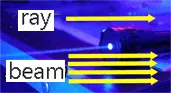
How can we model a light beam? First, we recall two important terms:
Light ray: a geometric line representing the path of light. It does not exist in nature; it is a conceptual tool.
Light beam: a collection of rays traveling in the same direction. Example: light entering a dark room through a small hole.
We model the light beam as follows:
- The light ray propagates as waves in the medium (ignored in the model for simplification).
- The light ray consists of tiny particles called photons (also ignored).
- Each beam consists of rays that cannot be perfectly parallel (in reality, rays from distant sources are nearly parallel; in modeling, we assume perfect parallelism).
📖 4 - Modeling Seeing an Object in Sunlight
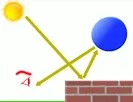
Sunlight shines on an object, and the reflected light enters our eyes. We can model it as follows:
- Steps 1–3 are similar to previous examples and are not repeated here.
- Sunlight hits specific points on the object, and in the model, reflection is considered only from those points.
- We only consider sunlight reflections; light from other sources is ignored.
📖 5 - Modeling a Parachutist

A parachutist jumps from an airplane. Many factors can be analyzed to create an acceptable model. Which factors can be ignored, and which cannot?
The effect of air resistance depends on the position of the body. Before the parachute opens, air resistance is small and can be neglected. After opening, air resistance significantly reduces speed to prevent injury. Therefore, the movement should be modeled in two parts.
Temperature, sunlight, and humidity have minor effects. However, strong wind can change the trajectory, because it affects the falling speed and direction.
📖 6 - Modeling Pushing an Object on a Horizontal Surface

We push an object on a horizontal surface. Assume the speed is low. Which factors can be ignored?
Because the speed is low, air resistance is negligible (note: at higher speeds, air resistance increases significantly; e.g., 5 times speed → 25 times air resistance).
Since the object slides on the horizontal surface and it is not stated that friction is absent, we cannot ignore friction. (In modeling, the problem may indicate this explicitly or implicitly; e.g., if the surface is slippery, we assume friction is negligible.)
Effects of temperature, humidity, and air pressure can be neglected. However, weight cannot be ignored, otherwise the object would float, like in space, which is unrealistic for modeling.
📝 Practice Quiz
modeling-in-physics
Frequently Asked Questions
📌 What is modeling in physics?
Modeling means simplifying a problem by removing less important details so that it can be solved📌 Which factors should be ignored or not ignored in modeling?
This is important because the answer depends on the problem. For example, in one case friction can be ignored, in another it cannot. Study the examples carefully.We Value Your Feedback
If you're satisfied with our service, a high rating would truly encourage our team. If you have concerns, we'd appreciate hearing your specific reasons in the comments so we can address them directly.
Number of votes = 1
Average rating 5 out 5
Comments Section
Answers to your questions about this lesson ( Modeling in Physics)Suggestions to improve site performance